Long-form · strategy
Rummy strategy: the math behind drop timing, discard reading and session length
The math of rummy strategy, in plain language. The page covers probability estimates, drop timing math, discard reading under uncertainty, and the practical decision criteria the desk uses in its strategy guide.
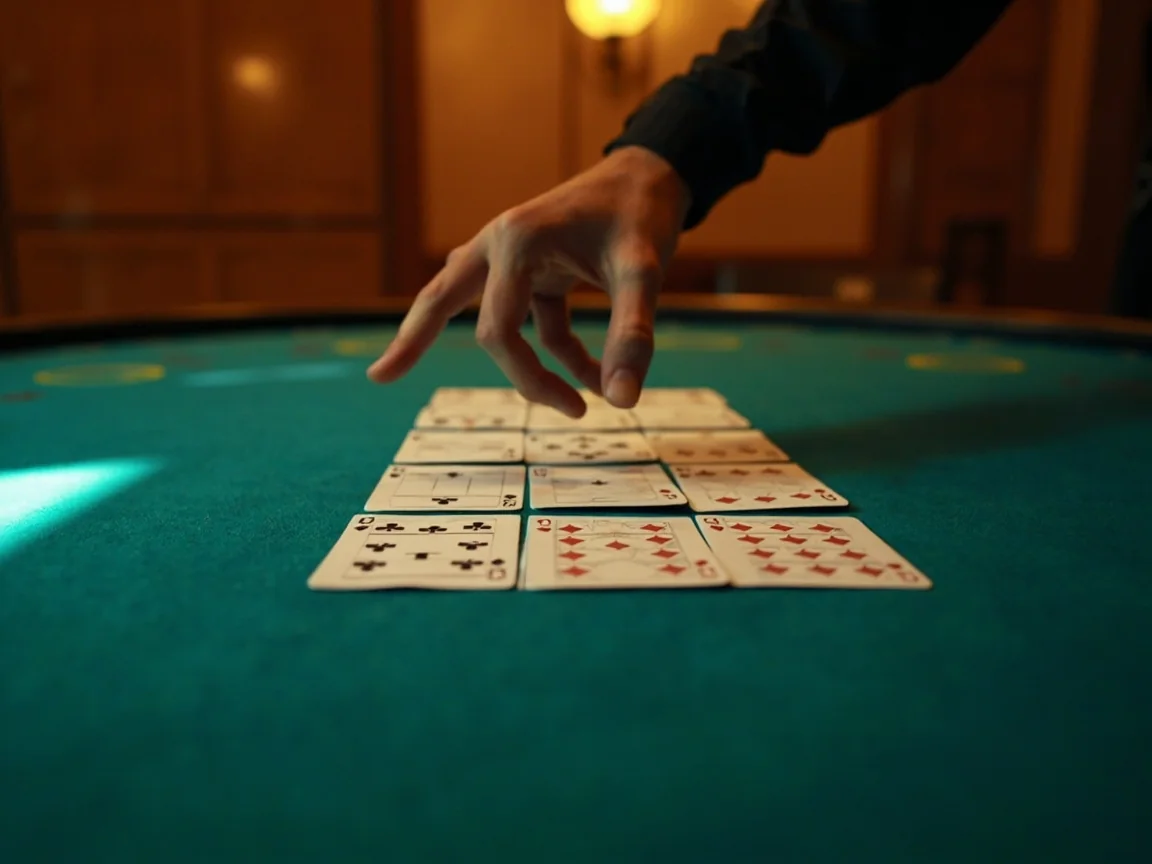
Rummy is a card game, but the strategy is mostly about decisions under uncertainty. The math is not the math of perfect information; the math is the math of "what is the expected value of this decision across many hands". Three decisions dominate the expected value: drop timing, pure-sequence completion discipline, and discard reading. The page is a long-form look at the math behind each.
Contents
Opening hand probability
At a six-player table, the chance of being dealt a usable joker in the opening 13 is roughly 60-65 percent (the printed joker plus the wild jokers in the deck). The chance of an immediate path to a pure sequence of three cards in the opening hand is roughly one in three. These are rough estimates; the precise number depends on the ruleset and the platform's deck.
The probability of a "great" opening hand, at least one pure sequence plus a usable joker, is roughly 20-25 percent. The probability of a "terrible" opening hand, no usable joker and no path to a pure sequence within two picks, is roughly 15-20 percent. The middle 55-60 percent is the "playable but not strong" range where the strategy is most useful.
Drop timing math
The drop is the most important decision in rummy. The math: on a Points table with per-point value of ₹1 and maximum loss of 80 points, dropping at the first pick costs ₹40. Continuing past the second pick with no pure-sequence progress risks the full ₹80 against an unknown hand shape. The expected cost of a blind continuation in the worst 15-20 percent of opening hands is higher than the drop cost.
The same shape applies to Pool 201 but with ceiling pressure. Late in the session, dropping near the ceiling can cost close to the full-hand value, so the early drop is the right call when the hand is not shaping up.
Pure-sequence completion
Until a pure sequence is locked, every discard is a higher-variance bet. The reason is structural: a hand without a pure sequence cannot declare; any grouping built on jokers alone can be broken by one wrong card from the deck. Locking the pure sequence early converts the hand from a high-variance bet into a controllable mid-game problem.
The practical habit is to identify the longest run in the opening hand and protect it from discards that could break the suit availability. If the run is 5-6-7 of hearts, the heart suit is now a constrained resource, discarding hearts beyond the seven risks breaking the sequence.
Discard reading under uncertainty
Discard reading is the most important skill in rummy once the rules are comfortable. The skill is not "counting cards" across deals, rummy has no memory across hands in Points and Deals formats, but noticing which cards an opponent is picking from the discard pile and which they are leaving.
If an opponent picks a 9♠ from the open pile, their hand probably has a sequence through that 9♠. If they leave a 9♠ on the open pile, their hand probably does not need that suit. The reading is local to the current hand, not cumulative across the session.
Pool ceiling pressure
Once a player's cumulative score is within 30 points of the Pool ceiling, the drop decision changes shape. Dropping at the first pick costs a fixed low value; dropping at the second pick costs more; dropping close to the ceiling costs close to the full value. Late-session players face a binary: drop cheap and lose ground, or stay in and risk elimination.
Players who do well in Pool 201 tend to play tighter in late session and looser in early session. The shift is not a personality change; it is a recognition that the cost of being wrong is larger late in the session.
Session length and fatigue
Decision quality drops sharply after ninety minutes of continuous play; the drop in quality is faster than most players notice. A two-hour session cap is a useful starting discipline. The cap is not about the table; the cap is about the player.
The same effect applies to single-hand decision time. A player who has been at the table for ninety minutes takes longer to identify a pure sequence and is more likely to make a discard error. The session cap is the cleanest defense.
Tilt and decision quality
A player who has just taken a bad beat makes worse decisions on the next two or three hands than a player who has just won. The remedy is to drop early on the next two or three hands regardless of hand quality; the saved cost is usually larger than the saved time.
The two-three-hand rule is the most useful anti-tilt tool because it is concrete. "Play more carefully" is too vague to be a rule. "Drop the next two hands regardless of hand quality" is concrete enough to be a habit.
Expected value across formats
Across many hands, three skills move expected value most: drop timing, pure-sequence completion discipline, and discard reading. Across a single hand, the dominant variable is the deck. Recognising which variable is in play at any given decision is itself a useful skill.
The expected value of a single hand is shaped by the format. Points has the highest per-hand variance; Pool 201 has the lowest per-hand variance but the longest session. Deals has its own shape per round. The format choice changes the shape of the variance, not the underlying skill.
A note on "house edge" and the rummy frame
Indian High Court rulings have held that 13-card rummy is predominantly a game of skill. The skill-game frame is what makes the format legitimate for real-money play in most Indian states. The frame is also what makes the strategy boundary real: a game of skill has a skill ceiling, and the strategy page is a way to map that ceiling.
What "house edge" means in a skill game
The house edge is the platform's cut of every hand. In a skill game, the house edge is small relative to the variance of the player's decisions; in a chance game, the house edge is the dominant variable. The 13-card rummy format is on the skill side of the line; the house edge is small relative to the player's strategy.
Why the frame matters for the player
The skill frame means the player's strategy moves the expected value. A player who locks the pure sequence, drops early, reads discards and caps the session will, across many hands, do better than a player who doesn't. The difference is not huge, but it is real, and it is the reason the strategy page exists.
Why the frame matters for the regulator
The skill frame is what keeps the format in the legal exemption. State-level rules on real-money skill games are written on the assumption that the format is skill-based. A platform that operates as a chance game, not a skill game, is operating outside the exemption. The reader should verify the platform's T&Cs page and the regulator's published list before staking.
Is Spin legal in my state? for the state-by-state rules summary.
A short glossary of strategy terms
Five strategy terms a reader is most likely to meet in a strategy guide or a T&Cs page. The terms are short, the definitions are short, and the framing is what the reader should look for in a T&Cs clause.
Pure sequence
Pure sequence is a run of three or more consecutive cards of the same suit, with no joker used. The pure sequence is the only mandatory meld in a 13-card declaration.
Impure sequence
Impure sequence is a run of three or more consecutive cards of the same suit, using a joker for a missing card. The impure sequence cannot replace a pure sequence at declaration.
Set
Set is three or four cards of the same rank in different suits. A 4-card set is permitted but rarely worth the cost of pulling four matching ranks from a 13-card hand.
Drop math
Drop math is the calculation of the cost of dropping versus continuing. The cost is platform-specific; the math is the same across formats. The /strategy/ page covers the math in detail.
Discard reading
Discard reading is the inference about an opponent's hand based on which cards they pick from the open pile and which they leave. The reading is local to the current hand, not cumulative across the session.
Rules walkthrough for the worked 13-card hand example.