How to play
How to play Indian 13-card rummy: dealing, drawing, melding and declaring
A first-session walkthrough. By the end of the article you should be able to sit down at a Points Rummy table with the smallest per-point value, follow the dealing and turn order, draw and discard, build melds and make a valid declaration at 13 cards.

Indian 13-card rummy uses two standard 52-card decks plus jokers, with 13 cards dealt to each player at a table of two to six. One card is placed face-up on the table to start the discard pile; the remaining deck becomes the closed stockpile from which players draw.
Dealing and turn order
The dealer is chosen at random; the deal rotates one seat clockwise each hand. After dealing, one card is turned face-up to start the discard pile and the rest of the stockpile is placed face-down beside it. The player to the dealer's left plays first. Turns move clockwise.
A single turn: draw, meld, discard
On your turn you take exactly one card, either the top card of the discard pile or the top card of the closed stockpile, and add it to your hand. You may then lay down any meld you have completed and discard exactly one card face-up onto the discard pile.
You can never end your turn with more than 13 cards or fewer than 13 cards in your hand. The number must stay at 13 from end of dealing through declaration.
The three kinds of meld
A meld is a valid grouping of three or more cards. There are three kinds:
- Pure sequence. Three or more consecutive cards of the same suit, no joker used. This is the only mandatory meld in a 13-card declaration.
- Impure sequence. Three or more consecutive cards of the same suit using a joker for a missing card.
- Set. Three or four cards of the same rank in different suits. (Within a single suit it would be a sequence.)
How the joker behaves
After the deal, one card is pulled at random from the stockpile and placed face-up under the stockpile as the printed joker. All jokers in the deck, printed and otherwise, are wild jokers; they can substitute for any missing card in an impure sequence or set. The face value of the printed joker does not matter; it is treated as a wild card.
Why a pure sequence is mandatory
The pure-sequence rule is the only structural protection against a hand being assembled purely from jokers and sets. Without a pure sequence, the wild joker could do all the work. With the rule in place, every valid declaration must include at least one run of consecutive same-suit cards with no joker involved.
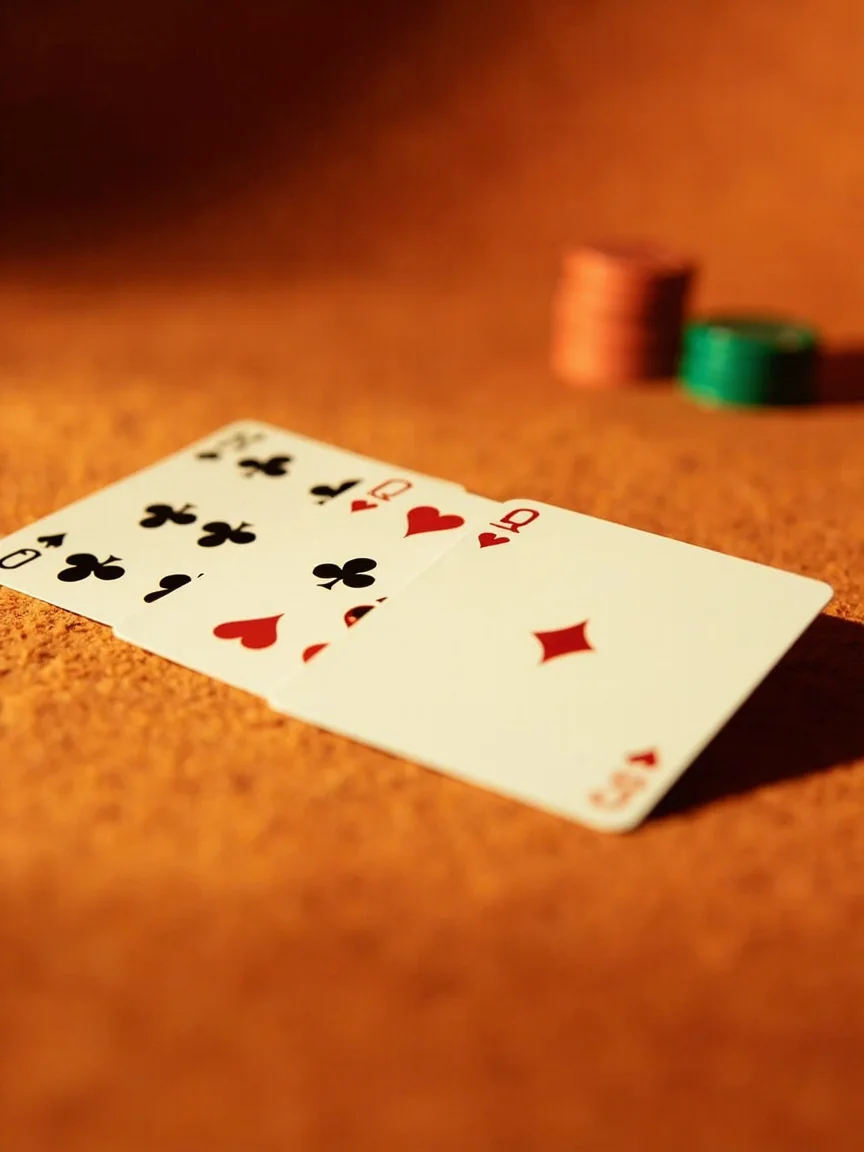
When an impure sequence is acceptable
An impure sequence uses a joker where the missing card would otherwise break the run. It cannot replace a pure sequence at declaration; it can fill the second pure-sequence slot or sit alongside as filler. Use an impure sequence when the deck simply did not give you the missing card, not as a substitute for finishing a pure sequence.

Set formation
A set is three or four cards of the same rank in different suits. If the cards happen to be in the same suit, the grouping is a sequence, not a set, sequences and sets do not overlap. A 4-card set is permitted but rarely worth the cost of pulling four matching ranks from a 13-card hand.
The declaration action
On the turn you intend to declare, you draw one card, lay down every meld you have completed, and place the final 14th card (your discard) face-down on the table to signal a declaration. The platform or the other players then verify your hand: one pure sequence must exist, and every card in your hand must belong to either a sequence or a set.
A wrong declaration is the most expensive single error in rummy. The penalty is the full value of the cards in your hand, typically 80 points if a single card is out of place. Take the extra second to count.
How scoring works
Cards count their face value; face cards count 10; aces count 1 or 11 depending on the ruleset. A valid declaration scores 0. A losing player pays the value of the cards left in their hand. Jokers left unused count as zero; printed jokers used as wild jokers count as zero in an impure sequence. Unmatched cards are stacked as the losing score.
When to drop
The drop is a single decision that changes the math of the session. Drop at the first pick and the cost is roughly half the full-hand value; drop later and the cost rises. If your opening hand has no path to a pure sequence in the first two or three picks, the drop is almost always cheaper than continuing.
A first-hand worked example
You are dealt 13 cards. Your first job is to find the longest pure sequence already in the hand. Suppose you have 5♥ 6♥ 7♥, that is a pure sequence, locked. Next, find the longest impure sequence using the wild joker. Suppose you have 9♠ 10♠ J♠ with the printed joker available, that is a second pure sequence, also locked. Then group the remaining cards by rank. If you find three 8s across three suits, you have a set.
Now your discards are the cards that do not fit any grouping. If the deck draws favourably, you keep your sequences intact and finish at 13 with one discard. If the deck draws awkwardly, you drop early and lose less than a wrong declaration.
Common first-hand mistakes
- Calling an impure sequence a pure sequence. If the joker is in your only run, you do not have a pure sequence yet.
- Discarding a card whose suit is exhausted in your own hand without checking whether an opponent could complete a pure sequence with it.
- Declaring when one group is still open. A wrong declaration costs the full hand value; the extra second is worth it.
- Holding high-value unmatched cards too long. If the deck is not showing enough matching cards, the card is dead weight.
- Ignoring the printed joker. The face value of the printed joker does not matter; the card is treated as a wild joker.
Quick glossary
- Meld. A valid grouping of three or more cards.
- Pure sequence. A run of consecutive same-suit cards with no joker.
- Impure sequence. A run of consecutive same-suit cards using a joker for a missing card.
- Set. Three or four cards of the same rank in different suits.
- Declaration. The action of laying down every meld to end the hand.
- Drop. Leaving the hand before drawing a card on a subsequent turn.
- Printed joker. The card placed face-up after the deal; treated as a wild joker.
- Wild joker. Any joker card, including the printed joker, used to substitute for a missing card.
A short reading list for the first month of play
Three habits that move expected value
Across many first-month sessions, three habits change the math more than any other. They are not clever; they are mechanical. The first is to lock a pure sequence before any other grouping. The second is to drop early when the opening hand offers no path to a pure sequence within two picks. The third is to take a single-window light selfie for the live photo KYC, the first time, not the third.
Each habit has a cost. The pure-sequence lock costs a player the option of a fast impure sequence. The early drop costs a player the chance of a recovery. The single-window selfie costs the player a minute of setup. Each habit buys a larger expected value than it costs; the math is in the strategy guide.
Two habits that look useful but are not
Two habits that look useful but do not move expected value: tracking cards across hands and adjusting the per-point value mid-session. The first does not apply because the deck is reshuffled every hand. The second is a tilt signal, not a strategy.
The strategy guide covers the habit list in detail. The point of the list above is the calibration: a beginner should treat the three useful habits as the floor and the two useless habits as the ceiling.
Read the strategy guide for the decision ledger and the drop math.